
Global Mining Stocks On Cusp Of Supercycle As AI Boom Stokes Metals

Global mining stocks have shot to the top of fund managers’ must-have list, as soaring metals demand and tight supplies of key minerals hint at a new supercycle in the sector.
With a nearly 90% gain since the start of 2025, MSCI’s Metals and Mining Index has beaten semiconductors, global banks and the Magnificent Seven cohort of technology stocks by a wide margin. And the rally shows no sign of stalling, as the boom in robotics, electric vehicles and AI data centers spurs metals prices to ever new highs.
That’s particularly true of copper, which is key to the energy transition and has surged 50% over the same period. But analysts are also bullish on a range of other minerals, including aluminum, silver, nickel and platinum. Gold, meanwhile, is expected to continue benefiting from US monetary and fiscal policy concerns, as well as geopolitical risks, even after hitting successive record highs.
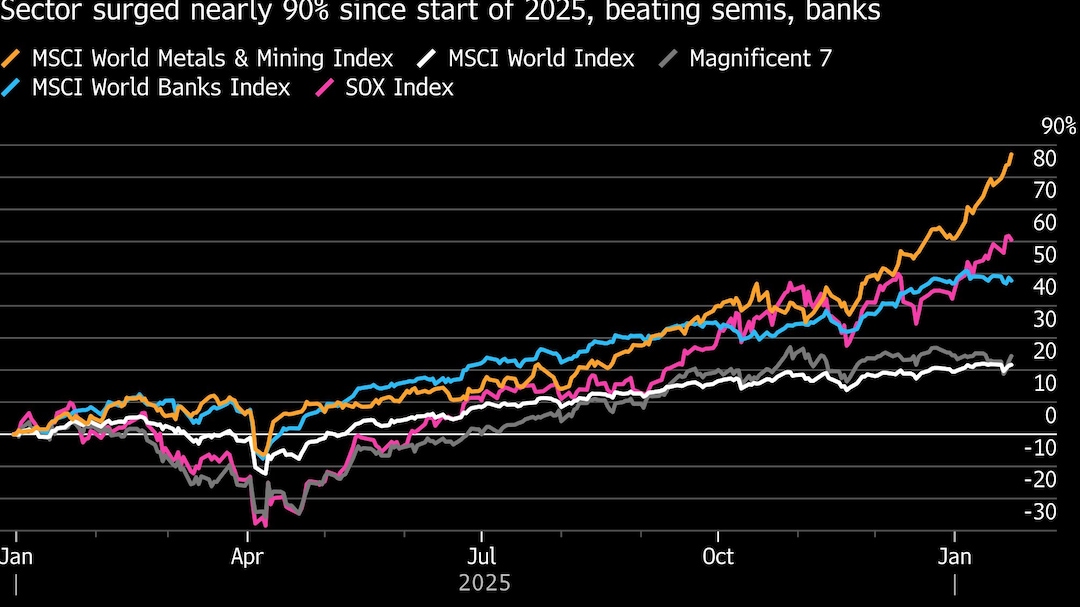
MSCI’s Metals and Mining Index has seen a nearly 90% gain since the start of 2025.
Photo Credit: Bloomberg
The outperformance is a stark reversal from prior years when the sector was out of favor, hit by volatile commodity prices and fears of a growth slowdown in China, the world’s largest metals consumer. But fund managers, who had piled into tech and financial stocks, now appear reassured by Beijing’s pledges to support the economy, including via interest-rate cuts.
“Mining stocks have quietly moved from a boring defensive sleeve to an essential portfolio anchor — one of the few sectors positioned to capture both shifting monetary policy dynamics and an increasingly volatile geopolitical landscape,” said Dilin Wu, a research strategist at Pepperstone Group Ltd. in Melbourne.
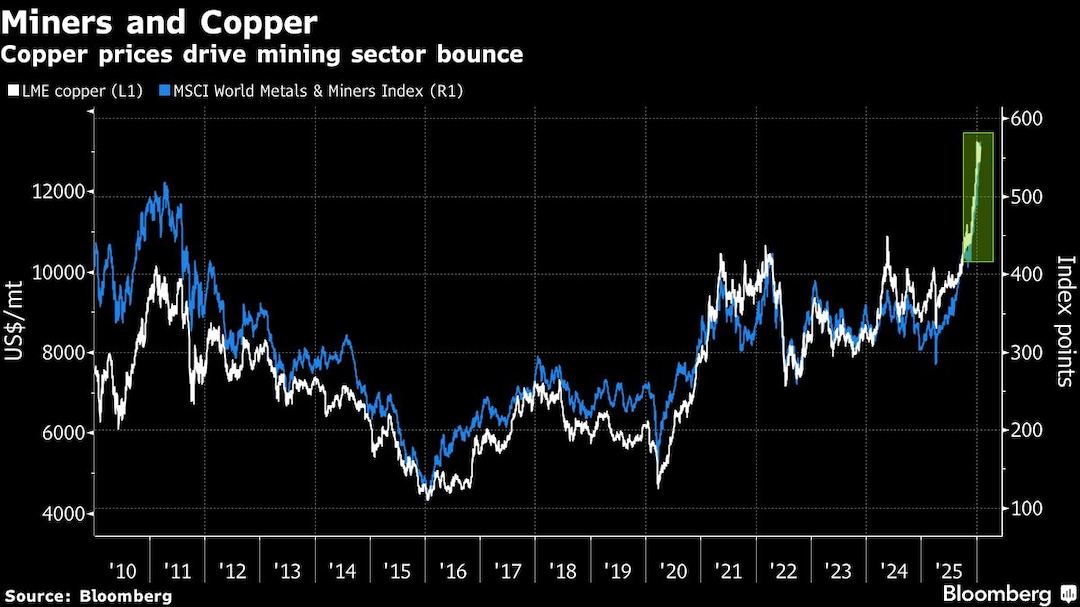
Photo Credit: Bloomberg
A major driver for the change is that commodities such as copper and aluminum have become less correlated to economic cycles. Historically seen as short-cycle trades, dictated by how fast or slow the world economy is growing, they have gradually morphed into structural investments.
In addition, they are benefiting from transition strategies, where investors buy assets such as metals to gain exposure to the AI theme.
Hence, the rush to buy the dip whenever weak data knocks mining stocks. European fund managers now have a net 26% overweight on the sector, according to Bank of America Corp.’s monthly survey. That’s the highest in four years, though still well below the 38% net overweight held in 2008.
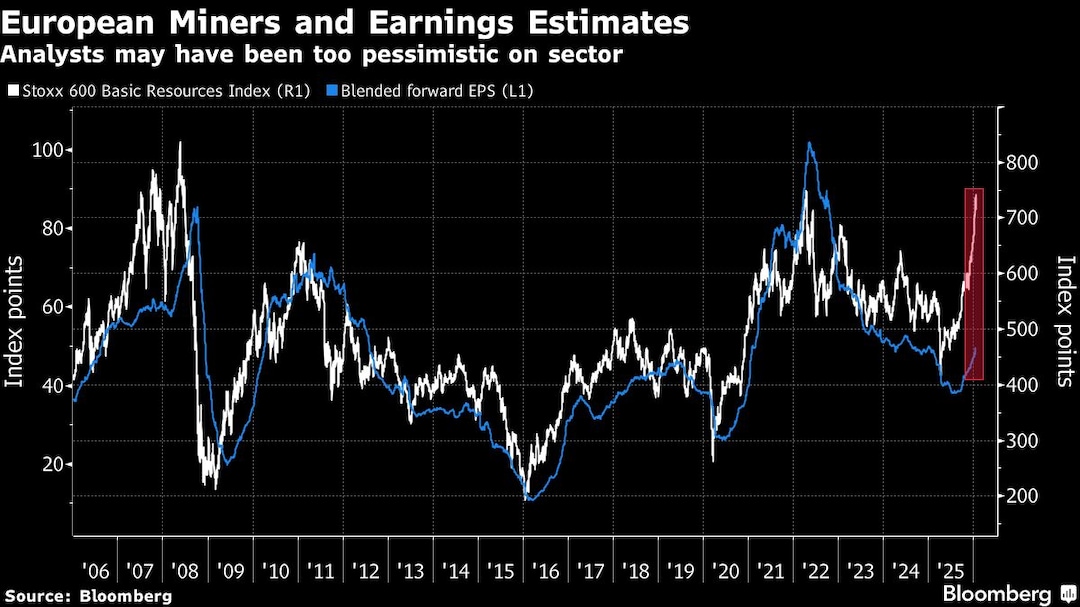
And yet, the sector looks pretty undervalued.
The Stoxx 600 Basic Resources index trades at a forward price-to-book ratio of about 0.47 relative to the MSCI World benchmark. That’s an about 20% discount to the long-term 0.59 ratio and well below prior cycle peaks above 0.7.
“This valuation gap persists even as the strategic relevance of natural resources has risen materially,” Morgan Stanley analysts led by Alain Gabriel wrote.
Gabriel also notes companies’ increasing preference for “buy over build.” Various M&A transactions are underway — notably Anglo American Plc’s acquisition of Teck Resources Ltd. and a potential merger between Rio Tinto Plc and Glencore Plc. While the industry’s capital-intensive nature is driving the trend, Morgan Stanley also attributes it to miners’ willingness to pursue scale and portfolio optimization, particularly in copper.
Given this is happening at a time of supply deficits, the backdrop should support higher commodity prices and valuation multiples, Gabriel added.
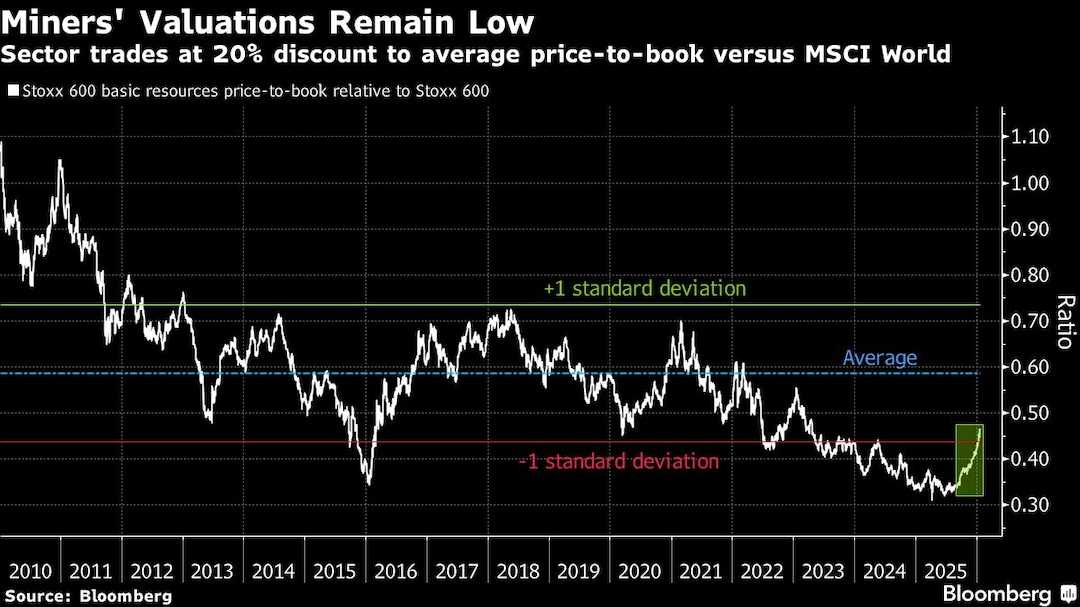
To be sure, top miners including BHP Group and Rio Tinto still derive the bulk of their earnings from iron ore, which is feeling the effects of the collapse of the last China-led supercycle. That’s motivating a push into copper M&A. Freeport-McMoRan Inc. and Antofagasta Plc are among the few firms offering pure exposure to copper.
For some, the pace of the rally is a reason for caution. BofA downgraded the sector to underweight in Europe, citing risks from negative economic surprises. Nick Ferres, chief investment officer for Vantage Point Asset Management in Singapore, said he’s trimmed gold exposure for now.
“I get concerned when the price of any asset moves non-linear or parabolic, that is why we are a bit cautious at the moment,” Ferres said. “But the miners are very inexpensive. If gold remains elevated, we would re-enter or scale back up on a pullback.”
Bloomberg Intelligence sees copper remaining in deficit this year, with supply shortfalls possibly worse than in 2025. On gold, BI analysts say bullion could push toward $5,000 an ounce, while Goldman Sachs Group Inc. expects it at $5,400 by end-2026 — about 8% above current levels.
“The upside drivers for commodities are now more powerful and more diversified,” said Gerald Gan, chief investment officer at Singapore-based Reed Capital Partners Ltd. “In the coming months, we plan to gradually increase our portfolio exposure to mining stocks.”
Watch LIVE TV, Get Stock Market Updates,
Top Business, IPO and
Latest News on NDTV Profit.