
Wall Street Grapples With New Risk: A European Buyers Strike

US Commerce Secretary Howard Lutnick told the elites gathered in Davos that the Trump administration believes globalization is “a failed policy” that left America behind. A day later, his boss, President Donald Trump, predicted the US stock market would double from records he openly took credit for.
There’s a stark tension lurking between the lines spoken by the two American billionaires: Foreign investors have had an insatiable appetite for US stocks over recent years, playing a huge role in driving benchmark indexes to the records Trump likes to boast about. Europeans, in particular, have been voracious buyers.
And while Trump lowered the temperature toward Europe, concern lingers on Wall Street that his belligerence and belittlement of the continent could take some of the biggest buyers of US equities out of the market. There are signs, in fact, that’s already beginning to happen.
“We are seeing more clients wanting to diversify away from the US. We saw that trend start in April 2025 but it has somewhat accelerated this week,” said Vincent Mortier, chief investment officer at Amundi SA, which is Europe’s largest asset manager with €2.3 trillion ($2.7 trillion) in assets under management.
He said any disentanglement will end up being a “long and complex process,” where clients need to figure out how they want to depart from main benchmarks, how they want to hedge against the US dollar.
European investors own roughly $10.4 trillion in US stocks — and more than half of that total is owned by investors in the very eight countries Trump threatened with tariffs, a move that contributed to a 2.1% drop in the S&P 500 on Tuesday.
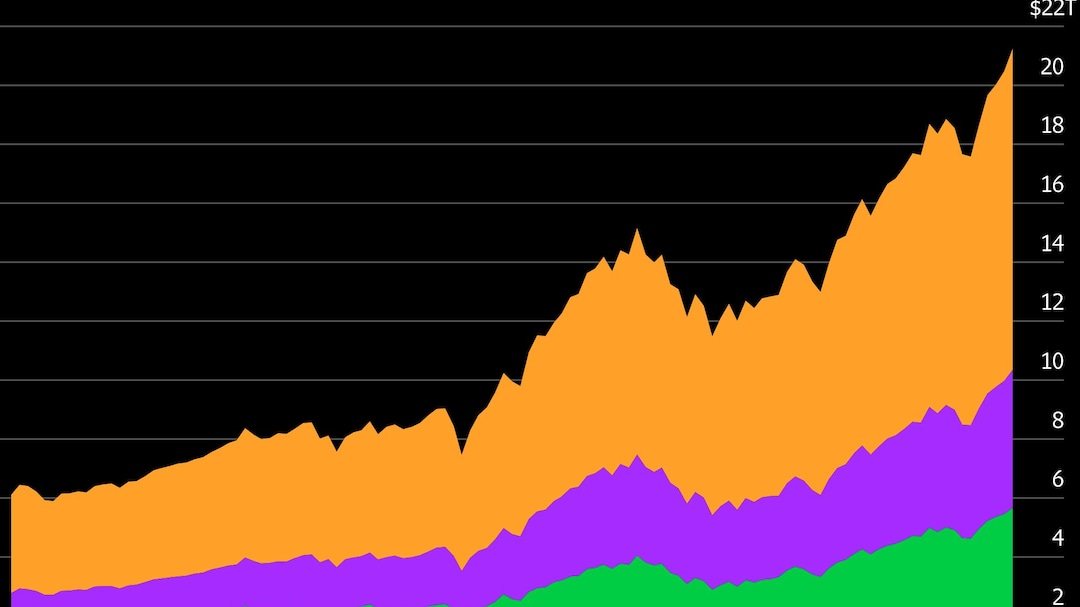
To put those numbers in context, Europeans own 49% of all US stocks held by foreigners — a big enough chunk to pose a threat to the market, Scotiabank portfolio and quantitative strategist Hugo Ste-Marie wrote in note.
“If we see diversification accelerating, it could weigh on US equities, bonds and the dollar over time,” he said.
To be clear, it is highly improbable that Europe would be able to, or even want to, act in concert to ditch US assets. The threat to Wall Street isn’t primarily, if at all, from government actions. But as Trump’s threats and insults persist, money managers from London to Berlin to Madrid have been increasingly fielding inquiries from clients about ways to at least lighten up on US assets.
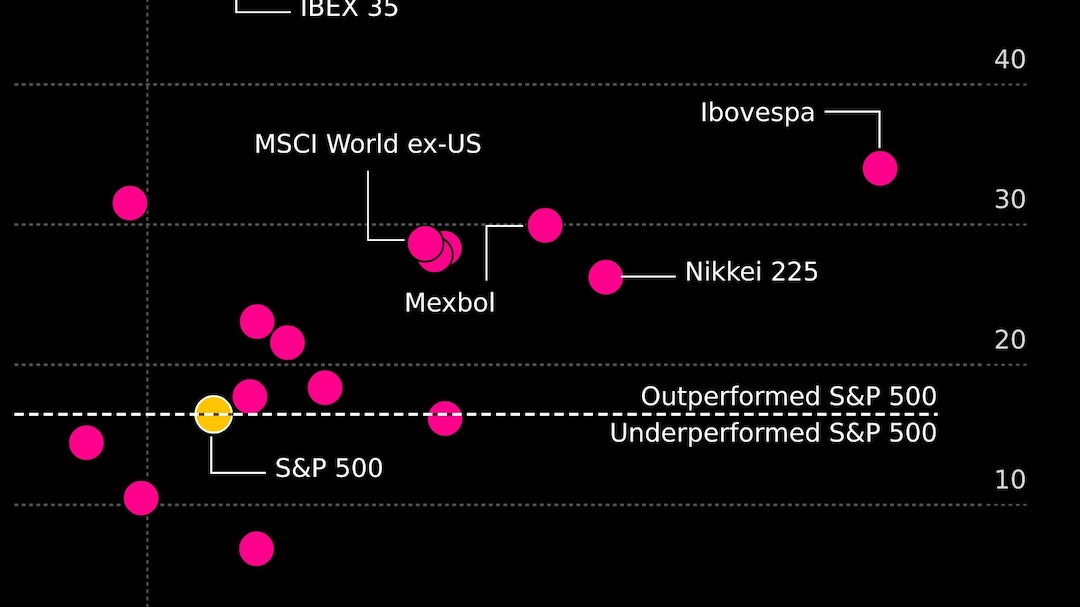
For years, that would’ve been a losing move, as American equities handily outperformed developed-market peers. But that’s changed since Trump’s inauguration as the dollar has weakened and European governments ramped up spending. Last year, the Stoxx 600 jumped 32% in dollar terms, Japan’s Topix gained 23% and South Korea’s Kospi surged 80% — while the US benchmark climbed 16%. Canada’s S&P/TSX Composite rose 28%, outperforming the S&P 500 by the widest margin in 20 years — and that’s before adjusting for the currency effect.
“If I was European, I would sit there and say, ‘we have US exposure, and there’s more opportunities elsewhere,’” said Michael O’Rourke, chief market strategist at JonesTrading Institutional Services LLC.
Selling would mark a sea change for European investors, who have seen their US holdings rise 91%, or by $4.9 trillion, in just the last three years, reflecting a combination of buying and price gains, according to Federal Reserve data released Jan. 9 and current through September. More current data is still delayed by the US government shutdown.
Greenland’s SISA Pension, which manages around 7 billion Danish kroner ($1.1 billion), has a roughly 50% exposure to the US, mainly in equities. Its board has been debating a divestment. So far, there has been little selling of equities even as pension funds, including Denmark’s AkademikerPension, are exiting US Treasury holdings.
True to his bellicose form, Trump has warned concerted or wholesale divestments would merit a “big retaliation,” keeping the stick of financial punishment firmly in hand. For some in Europe, the threats have become too much.
“After five years of substantial inflows into US assets — and given dollar weakness and the growing weaponization of the US currency — diversification is now front of mind for most institutional investors,” said Raphael Thuin, head of capital markets strategies at Paris-based Tikehau Capital SCA, with over €50 billion ($59 billion) under management. He said the topic is coming up frequently with clients in Europe and Asia.
“As investors reposition for a new cycle, we believe allocations to European assets could accelerate this year,” he said.
While the threat to American equities from a European buyers’ strike is, for now, limited, it adds to the list of risks for a market trading at historically high valuations.
“This is really an environment where you don’t want to be all exposed to US equities or US assets, especially not the dollar,” said Mathieu Racheter, head of equity strategy at Julius Baer & Co., with 520 billion Swiss francs ($662 billion) in assets under management.
There is a precedent for selling US assets in protest of Trump’s threats. Last year, Canadians demanded their pension fund managers reduce holdings of US stocks after the US president said he would use “economic force” to make the country the 51st state. At Davos, Prime Minister Mark Carney said countries that used to rely on financial integration with the US need to reconsider since Trump has turned that co-dependency into a weapon.
“If you asked an economist what the textbooks say what happens with tariffs, it’s that it would be difficult for the exporting country, but what we’re seeing right now, at least in financial markets, is kind of the opposite,” said Sebastien Page, chief investment officer at T. Rowe Price, which manages nearly $1.8 trillion. “It motivates domestic investments and it motivates diversifying trade partners.”
So far, daily ETF flow data shows there has been “little change” in foreign investor demand of US equity funds, JPMorgan Chase & Co. strategists led by Nikolaos Panigirtzoglou wrote Wednesday.
That could change in the coming months.
“One can’t rule out longer term that the weight of the US will be readjusted moving forward,” said Benjamin Melman, chief investment officer at Edmond de Rothschild Asset Management, which manages assets worth 184 billion Swiss francs ($234 billion).
The problem stems from the US seemingly abandoning the rules-based international order it has previously supported, which means investors can’t trust the US dollar or investments going forward, said Lars Christensen, CEO and head of analysis at Paice, a financial advisory firm.
“It is not a question about Europe standing up to the US,” he said in a post on X. “It is a question about being prudent with our investments — about reducing risks.”
Watch LIVE TV, Get Stock Market Updates,
Top Business, IPO and
Latest News on NDTV Profit.


