
Rhinos roamed Western Ghats foothills 3,500 years ago: Study | India News
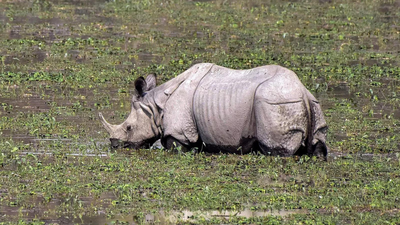
CHENNAI: Rhinoceros, now found only in the swampy grasslands and riverine forests of Assam, Bengal and Uttar Pradesh, roamed the foothills of the Western Ghats near Coimbatore some 3,500 years ago, archaeologists say. A team identified four bone fragments — two metacarpals and two carpals of the foot of an Indian rhino — at Molapalayam, a neolithic site. During the two seasons of excavations in 2021 and 2024 at the site, archaeologists unearthed a huge collection of bone fragments of 28 species of animals, including the Indian rhino.“The anatomical features of the bones match the rhino bones available in the reference collection,” said Abhayan G S, a faculty member at the department of archaeology, University of Kerala, who studied the samples with research scholar Ajith M.This is the third such find in south India after the bone fragments of a rhino were found in Payyampalli in Tirupattur district, and a fragmented skull of a fossilised rhino in Sathankulam in Tuticorin district. “This is a significant find as rhinos survived up to the middle of the second millennium BCE. According to the current zoogeography, the animal is restricted to Assam and north-eastern plains of India,” Abhayan said.The animal needs grasslands and marshes. “The foothills of the Western Ghats might have had grassland, as a single rhino requires many square kilometres of grassland for food,” said zooarchaeologist Pramod Joglekar, a retired professor of archaeology at Deccan College.“In Gujarat and Haryana, too, we found bone remains of the Indian rhino from the Harappan period. We also found bone remains in Odisha. It shows that rhinos were once spread across the Indian subcontinent,” he said.Archaeologist V Selvakumar of the department of maritime history and maritime archaeology at Tamil University, Thanjavur, who excavated the Molapalayam site, presented a paper on the finding at an international symposium on recent scientific studies in archaeology of Tamil Nadu in Madurai on Saturday.“A faunal analysis reveals that people who lived here constituted a pastoral community that reared cattle, sheep and goat. They also hunted animals such as deer and antelope. Their food also included a diverse range of small millets and pulses,” Selvakumar said.Researchers Sathish Naik and Aditya of Deccan College identified plants from the site. An analysis of bone fragments at the site found 28 species of animals, including cattle, buffalo, goat, sheep, pig and dog, and wild animals such as nilgai, blackbuck, four-horned antelope, gazelle, chital and sambar deer, besides the Indian rhino.Radiocarbon dating has assigned 1,600 BCE to 1,400 BCE as the period of the site.