A Renaissance Madonna in Delhi set to open a dialogue on motherhood between India and Italy | India News
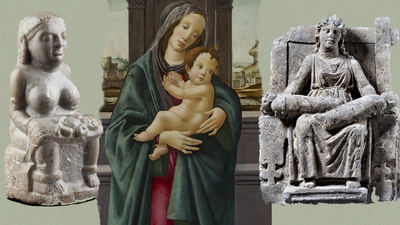
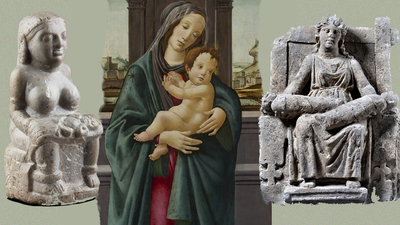
Before Leonardo da Vinci and Raphael, there was Botticelli. The older pioneer of the Italian Renaissance, celebrated painter Sandro Botticelli, was known to repeatedly return to the figure of Madonna and Child, making it his most enduring artistic subject. Unlike earlier medieval artists who painted Mary as a rigid, smiling queen, Botticelli focused on her human psychology. His Madonnas are famously melancholic, looking down with a heavy expression as if they can already foresee the future sacrifice of the infant Christ. Throughout his lifetime, Botticelli painted more than 40 variations of the subject.Now, one of these works—Madonna and Child (circa 1490), a tempera painting on loan from Florence’s Museo Stibbert—has travelled to New Delhi. It will serve as the centrepiece of ‘One Mother, Many Mother Tongues’, an exhibition opening on June 22 at the Humayun’s Tomb Museum that explores traditions of motherhood in India and Italy. It is the first time an original Botticelli masterpiece is being shown in India, following last year’s successful Indian tour of the baroque masterpiece, Caravaggio’s ‘Mary Magdalene in Ecstasy’ (1606).Co-curated by art historian Naman P Ahuja and Andrea Anastasio, director of the Italian Cultural Centre in India, the exhibition is the result of an increasingly close cultural partnership. On May 20, India and Italy officially elevated their bilateral ties to a special strategic partnership, paving the way for next year to be declared the Italy-India year of culture and tourism, featuring a rich calendar of events spanning cinema, restoration, design and performing arts.Spanning more than two millennia, the exhibition moves away from a single, universal story of motherhood. By mapping artworks from across both peninsulas, the show explores how the image of the mother and child has been reimagined across centuries, regions and belief systems, revealing striking formal resonances between vastly different cultures. Indian highlights include the enormous Gandharan sculpture of Hariti from Skarah Dheri (from present-day Peshawar), paired with Kushan-period Hariti figures from Mathura and Andhra Pradesh, illustrating the spread of the mother-goddess cult across the subcontinent by the second century CE. A sixth-century Skandamata from a temple near Thaneshwar in Udaipur district represents another key work.From Italy come representations of Mater Matuta, the ancient goddess of dawn and childbirth. These images too present seated female figures holding one or more children upon their laps.A similar idea appears in the Buddhist figure of Hariti. According to tradition, Hariti was once a child-stealing demon who abducted children but was later converted by the Buddha into a benevolent guardian. Enthroned and surrounded by children, her transformed body becomes a site of redemption. The sculpture from Skarah Dheri is especially important because it comes from Gandhara, a region shaped by exchanges between South Asia, Central Asia and the Mediterranean world. When placed alongside representations of Mater Matuta, the sculpture reveals both similarities and differences in how societies imagine motherhood.Coming back to Botticelli’s work, the relationship between mother and son unfolds with a delicacy of gesture and a restrained tenderness that intensifies the sacred dimension, turning motherhood into an inward and spiritual experience.To build this dialogue, more than a dozen museums, institutions and foundations from both Italy and India have loaned their artefacts. These include the National Museum of India in New Delhi, the Indian Museum in Kolkata, the Government Museums in Mathura and Udaipur, the TAPI Collection, the Museo Stibbert in Florence, the Museo Etrusco in Rome and the Museo Provinciale Campano di Capua.The exhibition asks visitors to recognise that our histories have always been plural. “‘My original work titled ‘One Mother Many Mother Tongues’, took on a case study of the ancient cult of the goddess Hariti which allowed me to demonstrate the nature of the huge shifts that happened in Indian culture because of the migration of people and communities 2,000 years ago,” says co-curator Naman Ahuja. “It showed how migration and localisation take place simultaneously, giving rise to transcultural societies. If our antiquity and tradition themselves are so plural, surely we should not be anxious about losing our culture in the wake of similar forces today?” asks Ahuja, who has brought attention to important traditions in Indian art in this exhibition. For example, while Pallava sculptures of Vishnu and Shiva are widely studied, figures such as Jyeshta, considered the antithesis of goddess lakshmi, are rarely discussed despite the many surviving examples across museums in India. Ahuja adds how the Skandamata sculptures from Thaneshwar are among the most beautiful representations of motherhood in Indian art, coming as they do from a crucial period in the development of Shakti worship and offer new ways of understanding maternal power. The exhibition also explores the traditions of tantric yoginis to expand our understanding of motherhood beyond biological relationships.Through the cross-cultural imagery of the mother and child, the exhibition hopes to reassure that plurality isn’t something to fear in the modern world. It is exactly what has enriched and sustained human culture for over two millennia. ‘One Mother, Many Mother Tongues’ will be on view at the Humanyun’s Tomb Museum from 22 June and will travel next to the National Gallery of Modern Art in Bengaluru