
Record 44.5GW green energy added in ’25
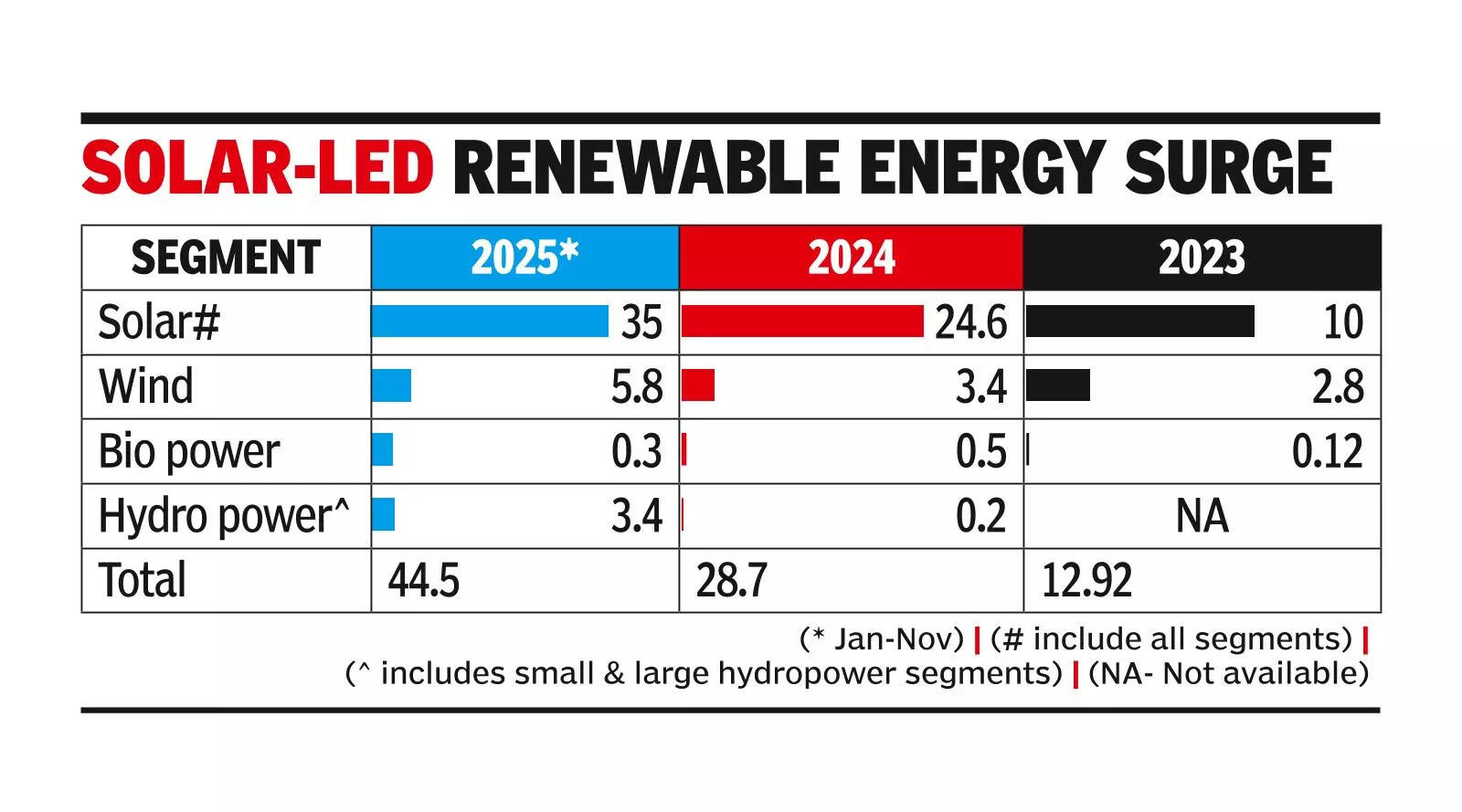
CHENNAI: The current calendar year proved to be a milestone for the Indian renewable energy sector, as annual new capacity additions to the grid hit a historic high. While final numbers are awaited in early Jan 2026, the sector has already added a whopping 44.5 GW of new capacity (including the large hydro category) during the 11-month period of 2025, led by the solar power segment.The calendar year 2024 saw an addition of about 28.7 GW of new capacity (including large hydro) to the grid. Renewable energy capacity (excluding large hydro) in 2025 has grown by 26% to 204 GW as of Nov 30, 2025. The growth recorded during the 11-month period is higher than the 21% growth achieved in the full CY 2024 (over 2023).
Solar-led renewable energy surge
As a result, total renewable energy capacity (excluding large hydro) has increased from 134 GW as of Dec 31, 2023, to 204 GW as of Nov 2025. India’s clean energy capacity continues to be driven by solar power, which added 35 GW (across all solar segments) to the grid during the 11-month period, compared with 25 GW added in 2024. Of the total 35 GW added by the solar segment in 2025, ground-mounted capacity accounted for about 26 GW, while the rooftop solar segment contributed 7 GW. Hybrid projects added close to 1 GW, with the remaining capacity coming from off-grid solar installations. Top states in solar power installed capacity include Rajasthan (36 GW), Gujarat (25 GW), Maharashtra (17 GW), and Tamil Nadu (12 GW). During the Jan-Nov 2025 period, the wind power sector added about 6 GW of new capacity-the highest-ever addition in recent years-indicating a strong revival after a subdued phase.Thus, as of Nov 2025, India’s total installed renewable energy capacity stood at 254 GW, comprising solar (133 GW), wind (54 GW), bioenergy (11 GW), small hydro (5 GW), and large hydro (50 GW, including pumped storage capacity), according to data from the union ministry of new and renewable energy. “An additional 135 GW of renewable capacity is under various stages of implementation or tendering. Tariff competitiveness remains strong, with record-low bids continuing in the range of Rs 2.44 to Rs 2.55 per kWh (approximately $29-$31 per MWh) for utility-scale solar, confirming the sustained cost advantage of clean energy technologies,” according to IEEFA.