
Union Budget 2026: Will you pay less tax this year? Middle class eyes fresh relief on Feb 1
Each year the Budget speech is eagerly watched and listened to by the common man and middle class taxpayers, seeking answer to a simple query: will my tax burden reduce this year? Even finance ministers presenting the Budget are aware of the populist impact of their speech, in case tax relief measures are announced.Finance Minister Nirmala Sitharaman will present the Union Budget on February 1. Will tax slab and tax rate changes be introduced? Sitharaman, who will present her ninth budget, is also the FM who introduced the new income tax regime back in 2020.The choice between the old and the new income tax regime is an important one and every year, taxpayers carefully calculate the tax liability under each before deciding on which one to opt for.Over the years, the new income tax regime has seen several changes, and the tax liability under it has progressively come down at various salary levels, and it has become increasingly more attractive compared to the old regime.
Why was a new tax regime introduced?
In her Budget speech in 2020, FM Nirmala Sitharaman explained the rationale for the introduction of a new income tax regime: the need for simpler compliance.“…The Income Tax Act is riddled with various exemptions and deductions which make compliance by the taxpayer and administration of the Income Tax Act by the tax authorities a burdensome process. It is almost impossible for a taxpayer to comply with the Income-tax law without taking help from professionals,” she said.Hence, a new and simplified income tax regime was introduced to provide “significant relief” to individual taxpayers. The idea was for a tax regime that offers reduced rates for taxpayers who forgo certain deductions and exemptions.New Income Tax Regime: Tax Slabs For FY 2020-21
The biggest takeaway was that the 30% tax slab under the new regime kicked in at an income above Rs 15 lakh compared to Rs 10 lakh under the old tax regime. At that time individuals under both regimes earning income up to Rs 5 lakh did not have to pay tax with the benefit of Section 87A.FM Sitharaman explained the gains: In the new tax regime, substantial tax benefit will accrue to a taxpayer depending upon exemptions and deductions claimed by him. For example, a person earning Rs 15 lakh in a year and not availing any deductions etc. will pay only Rs 1,95,000 as compared to Rs 2,73,000 in the old regime. Thus his tax burden shall be reduced by 78,000 in the new regime. He would still be the gainer in the new regime even if he was taking deduction of Rs 1.5 Lakh under various sections of Chapter- VI-A of the Income Tax Act under the old regime.
Evolution of New Income Tax Regime
Over the years, the government has introduced substantial changes under the new income tax regime – introduction of standard deduction benefits, higher standard deduction limit of Rs 75,000, evolving tax slabs and tax rates.In the Union Budget 2023, tax slabs under the new regime were further tweaked to:New Income Tax Regime: Tax Slabs For FY 2023-24
Importantly the following big changes were introduced:
- Tax exemption limit under new regime was hiked to Rs 3 lakh
- Standard deduction benefit of Rs 50,000 was introduced in new regime
- Section 87A rebate limit under new regime was hiked to Rs 7 lakh, which meant that those earning up to Rs 7 lakh would pay no tax! This limit was maintained at Rs 5 lakh under the old tax regime
- The highest surcharge rate was reduced to 25% from 37%, bringing down the highest tax rate from 42.74% to 39%.
- The new income tax regime was made the default regime
In the interim budget of 2024, the standard deduction under the new regime was raised to Rs 75,000.
The Rs 12 Lakh Tax-Free Bonanza
Last year, FM Sitharaman’s Budget brought sweeping changes in the new income tax regime, making it even more attractive for taxpayers. With higher rebate, tax outgo on income up to Rs 12 lakh was reduced to ZERO!Explaining the journey, Sitharaman said, “Right after 2014, the ‘Nil tax’ slab was raised to Rs 2.5 lakh, which was further raised to Rs 5 lakh in 2019 and to Rs 7 lakh in 2023. This is reflective of our government’s trust on the middle-class tax payers. I am now happy to announce that there will be no income tax payable up to income of Rs 12 lakh (i.e. average income of Rs 1 lakh per month other than special rate income such as capital gains) under the new regime. This limit will be Rs 12.75 lakh for salaried tax payers, due to standard deduction of Rs 75,000.”Income tax slabs under the new regime saw big changes, with the 30% tax slab now kicking in for incomes above Rs 24 lakh, as against Rs 15 lakh earlier.
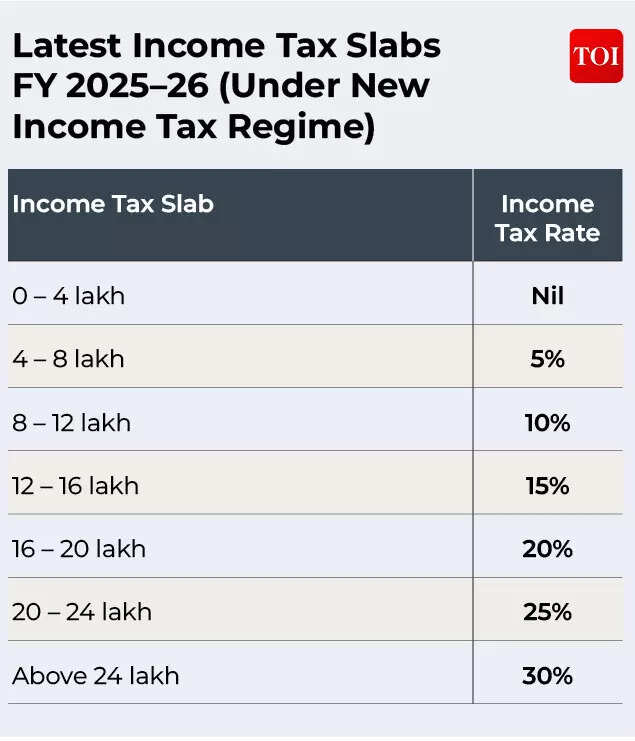
Latest Income Tax Slabs FY 2025–26 (Under New Income Tax Regime)
Old Vs New Income Tax Regime: How Much More Tax Are You Saving Over Years?
One noteworthy point is that in all these years since the introduction of the new income tax regime, the old tax regime with higher deductions and exemptions but also higher tax rates continues to function, though without any changes. The intent of the government is clear: with the new tax regime made the default regime, and all changes and benefits of lower taxes, taxpayers are being urged to shift to it.
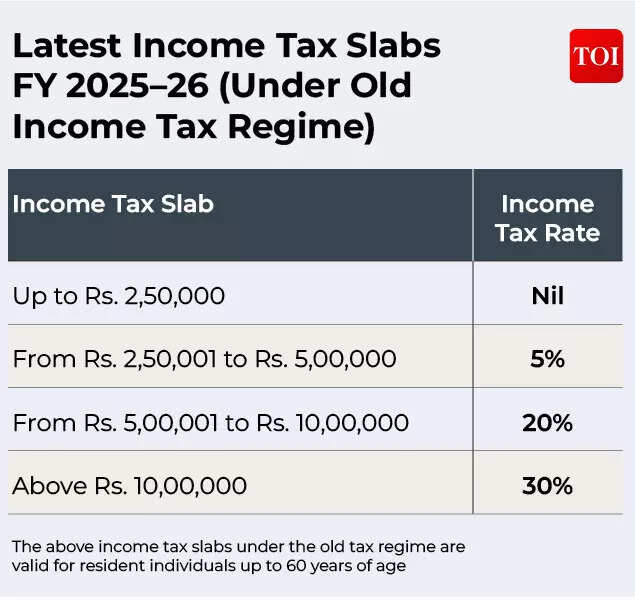
But, how much is the tax benefit under the new tax regime compared to the old regime? The tax outgo has changed in the last 5 years, and at various income levels, the tax outgo under the new regime has come down substantially compared to the old tax regime.For a better understanding, we take a look at how tax outgo has changed over the last five years at various income levels of Rs 10 lakh, Rs 20 lakh, and Rs 40 lakh. If for an income level of Rs 10 lakh, you had to pay Rs 75,400 in FY21 under the old tax regime, the tax outgo under the new regime has come down from Rs 78,000 in FY21 to Rs 54,600 in FY24, Rs 44,200 in FY25 to NIL in FY26! It continues to be Rs 75,400 under the old regime. Similarly, if for an income level of Rs 20 lakh, you had to pay Rs 366,600 in FY21 under the old tax regime, the tax outgo under the new regime has come down from Rs 351,000 in FY21 to Rs 296,400 in FY24, Rs 278,200 in FY25 to Rs 192,400 in FY26! So in FY26, if you opt for the new regime, instead of the old, your tax savings would be Rs 174,200! The impact is also visible at higher income levels. If for an income level of Rs 40 lakh, you had to pay Rs 990,600 in FY21 under the old tax regime, the tax outgo under the new regime has come down from Rs 975,000 in FY21 to Rs 920,400 in FY24, Rs 902,200 in FY25 to Rs 787,800 in FY26! So in FY26, if you opt for the new regime, instead of the old, your tax savings would be Rs 202,800!These charts by EY have been prepared on the following assumptions:
- Section 80C deduction (maximum Rs 1.5 lakh) considered under the old tax regime.
- Other deductions/ exemptions such as medical insurance, home loan interest, house rent allowance are not considered.
- Standard deduction of Rs 50000 under the old regime and standard deduction as notified from time to time (Nil, Rs 50,000, Rs 75,000) under new regime is considered.
The above charts are broadly indicative, and the tax outgo will depend on your income level, the amount of deductions and exemptions you claim. For an income of over Rs 12 lakh, and above a certain amount of deductions and exemptions, the old regime may be more suitable at various salary levels.Hence, while the above examples offer a clear picture on how the tax benefits have increased over years under the new regime, it is important to calculate the total amount of deductions and exemptions you avail for a better understanding.As an example, at the current tax slabs in the old and new regime, if you have a gross income of more than Rs 24.75 lakh, then the old regime makes sense only if your total deductions and exemptions are over Rs 8 lakh.This level of deductions and exemptions is for the 30% tax slab. It will vary for incomes below Rs 24 lakh.Amarpal Chadha, Tax Partner at EY India tells TOI, “Over the past few years, the new tax regime has clearly boosted the take‑home pay of most salaried taxpayers due to the rising basic exemption limits and reduced slab rates. In FY 2020-21, for an income of Rs 10 lakh, the tax liability under the new tax regime was slightly higher compared to the old tax regime. However, over the subsequent five years (FY 2021-22 to FY 2025-26), the reforms have reversed this picture, resulting in savings of Rs 75,400 in FY 2025-26 under the new tax regime as compared to the old tax regime.” “For an income of Rs 20 lakh and Rs 40 lakh, the savings in FY 2025-26 are approximately Rs 1.74 lakh and Rs 2.02 lakh respectively as compared to the old tax regime. Now, if we compare savings under the new tax regime over the six-year period (FY 2020-21 to FY 2025-26), savings have risen significantly — around Rs 78,000 at an income of Rs 10 lakh, Rs 1.58 lakh at Rs 20 lakh and Rs 1.87 lakh at Rs 40 lakh. With substantial taxpayers going ahead with the default/new tax regime, further slab adjustments in Budget 2026 could accelerate this trend,” he adds.While a certain percentage of taxpayers continue to benefit from the old tax regime, for example those who claim high levels of House Rent Allowance, or those who have a home loan, over 70% of tax returns filed for AY 2024-25 were under the new regime. Tax experts expect more taxpayers to switch to the new income tax regime in the ongoing financial year, with the Rs 12 lakh zero tax level prompting many to shift.However, experts note that the government may look to introduce some popular deductions and exemptions such as Section 80C and home loan interest benefits to incentivise savings and housing.