What Changes, What Gets Cheaper, And Which Sectors Get A Boost

India and the European Union have concluded negotiations on a landmark Free Trade Agreement (FTA), one of the largest and most comprehensive bilateral trade deals ever. The agreement links economies that together account for around 25% of global GDP, positioning India and the EU as trusted partners at a time of geopolitical fragmentation and supply-chain realignment.
Legal scrubbing of the agreement is now underway, with the government aiming to release the legally cleared text within the next two weeks. Following ratification on both sides, the agreement is expected to enter into force about a year from now.
According to the Commerce Ministry, bilateral trade in goods and services between India and the EU stood at over $219 billion in 2024-25.
Why This Is India’s Most Comprehensive FTA Yet
The Commerce Ministry said the India-EU FTA covers goods, services, digital trade, SMEs, mobility and sustainability, making it India’s most wide-ranging trade agreement to date. Structurally, it is deeper than many of India’s past FTAs because the EU is a customs union, offering uniform market access across all member states rather than fragmented country-by-country openings.
A key headline number? The agreement gives preferential market access to over 99% of Indian exports by value into the EU, according to the ministry.
What India Gets: Zero Tariffs!
For Indian exporters, the immediate gains are significant. The EU will eliminate tariffs on 90% of Indian imports from Day One, with additional tariff lines phased out or covered under quotas. In total, 96.8% of EU tariff lines will be opened for India.
The Commerce Ministry said nearly $33 billion worth of Indian exports will benefit immediately from zero-duty access when the agreement comes into force.
Labour-intensive sectors are the biggest winners:
- Textiles and apparel
- Leather and footwear
- Gems and jewellery
- Marine products
- Chemicals and consumer goods
Tariffs in these categories will fall to zero on entry into force, a major boost for employment-heavy industries.
Average EU tariffs on Indian goods will drop sharply-from about 3.8% to 0.1%, dramatically improving price competitiveness for Indian exporters.
What Gets Cheaper For India?
Non-Agricultural Products
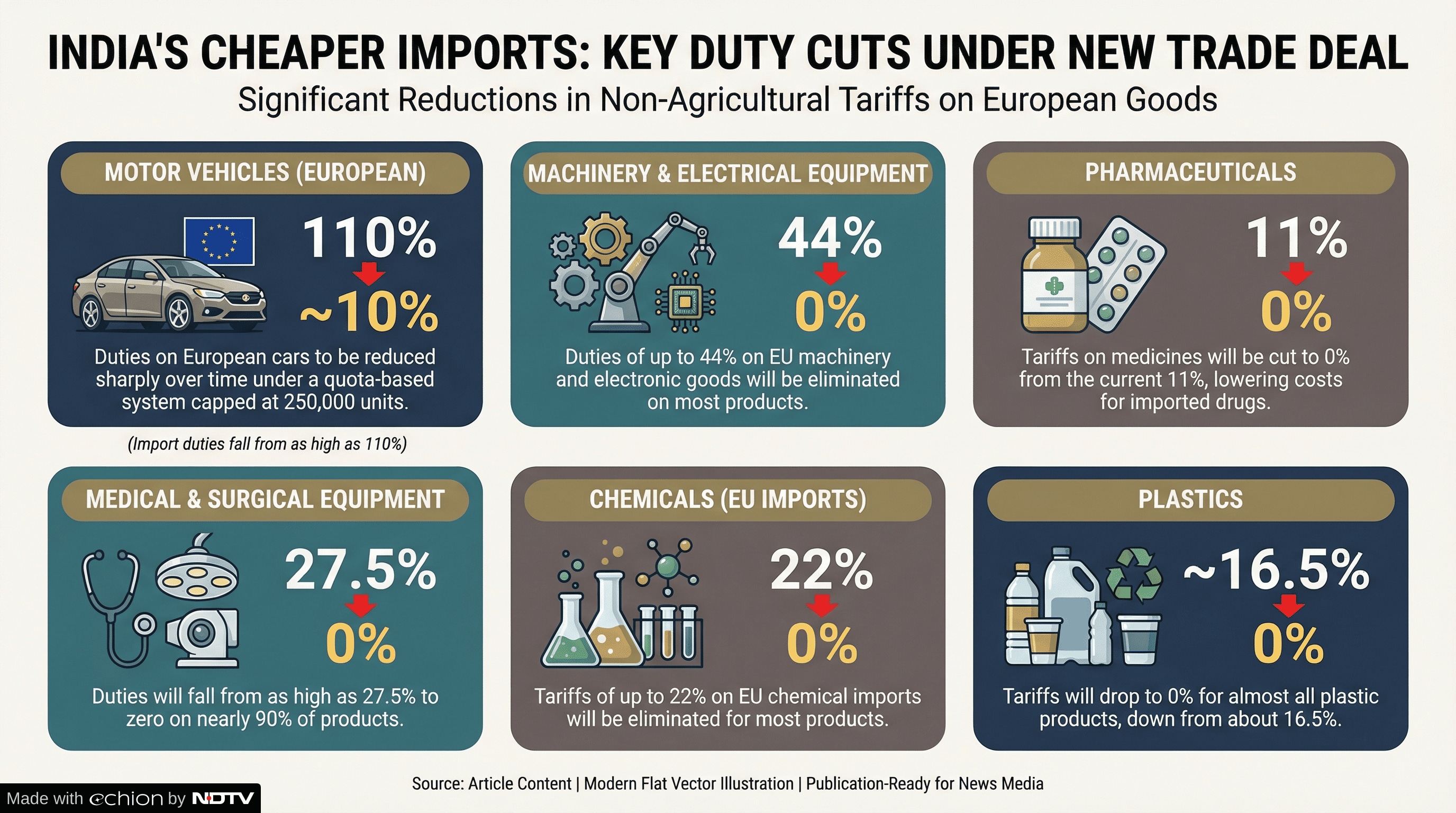
- Motor vehicles: Import duties on European cars will be reduced sharply over time, from as high as 110% to around 10%, under a quota-based system capped at 250,000 units.
- Pharmaceuticals: Tariffs on medicines will be cut to 0% from the current 11%, lowering costs for imported drugs.
- Machinery and electrical equipment: Duties of up to 44% on EU machinery and electronic goods will be eliminated on most products.
- Aircraft and spacecraft: Tariffs will be reduced to 0% from the current 11% on most aircraft-related products.
- Optical, surgical and medical equipment: Duties will fall from as high as 27.5% to zero on nearly 90% of products.
- Plastics: Tariffs will drop to 0% for almost all plastic products, down from about 16.5%.
- Pearls, precious stones and metal jewellery: Duties of up to 22.5% will be cut to zero for around 20% of products, with phased reductions for another 36%.
- Chemicals: Tariffs of up to 22% on EU chemical imports will be eliminated for most products.
- Iron and steel: Most iron and steel products will attract zero import duty.
Agricultural and Food Products
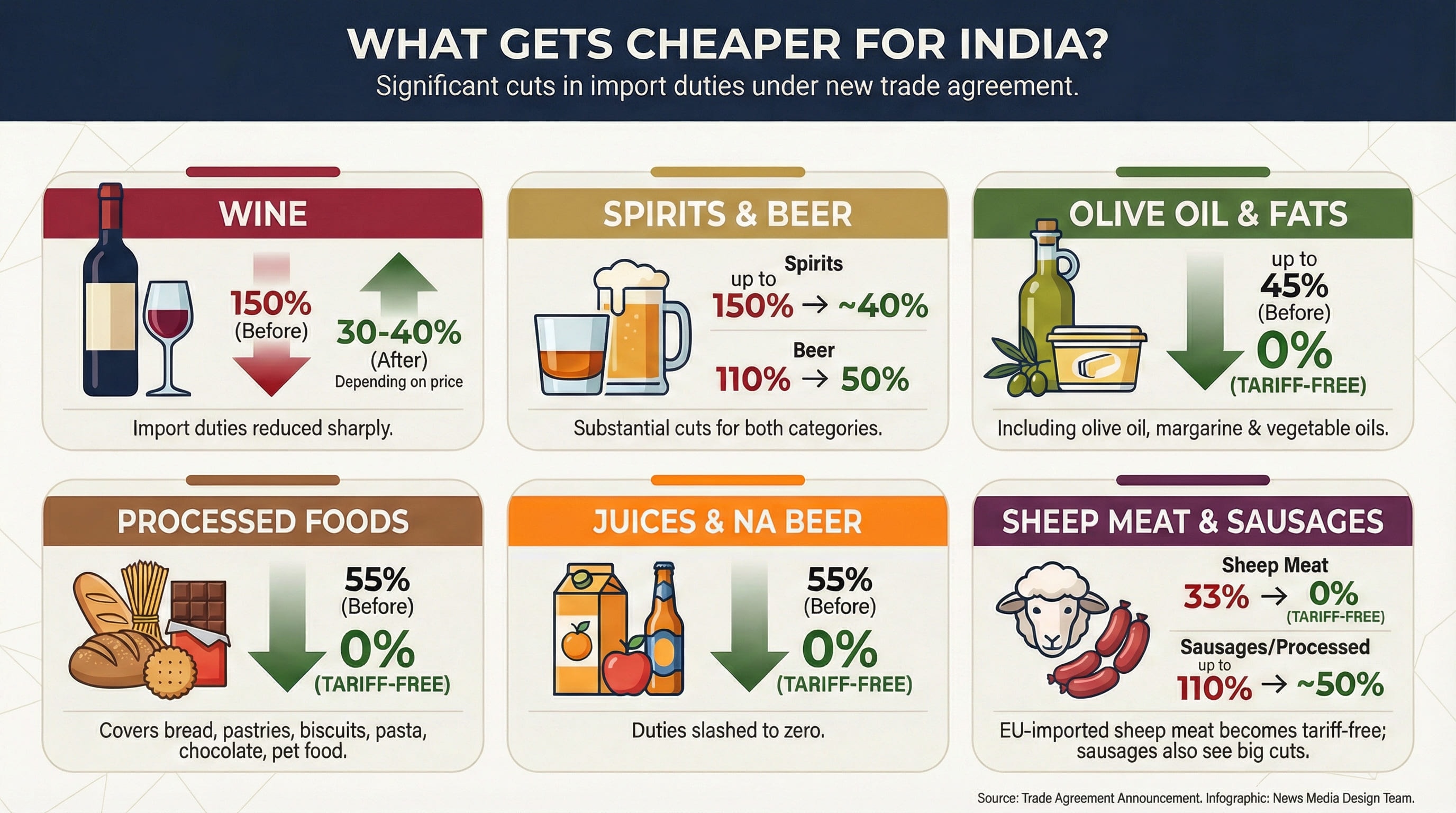
- Wine: Import duties on EU wine will be reduced sharply from 150% to 30%-40%, depending on price segments.
- Spirits: Customs duties will fall from up to 150% to about 40%.
- Beer: Duties on imported EU beer will be cut from 110% to 50%.
- Olive oil, margarine and vegetable oils: These products will become tariff-free, down from duties as high as 45%.
- Kiwis and pears: Tariffs will be reduced from 33% to 10%, within quota limits.
- Fruit juices and non-alcoholic beer: Duties will be slashed from 55% to zero.
- Processed foods: Products such as bread, pastries, biscuits, pasta, chocolate and pet food will become tariff-free, down from 55%.
- Sheep meat: EU-imported sheep meat will attract 0% duty, compared with 33% currently.
- Sausages and processed meats: Tariffs will be reduced from up to 110% to around 50%.
What EU Gets: Access To a Developing Market
In return, India will cut tariffs to zero on 93% of EU imports over a 10-year period, rising to 97% when quotas are included. India will open 92.1% of tariff lines and 102 services sub-sectors for EU firms.
India’s weighted average tariff will fall from 6-7% to about 2.8% over a decade, giving European exporters long-term access to one of the world’s fastest-growing large markets.
Autos, Agriculture and Sensitive Sectors
The Commerce Ministry said no market access has been offered in sensitive areas like dairy and select agricultural products, protecting domestic farmers.
Auto liberalisation will be quota-based and carefully calibrated, designed to avoid disruption to domestic manufacturing. Lower-priced cars remain largely outside the EU’s interest, while premium vehicles will be allowed limited, phased access.
Beyond Goods Trade
The EU will also open its markets to Indian services across IT, professional services, education and business services, while India will also open selected services sub-sectors to European firms.
Crucially, the deal includes mobility provisions. According to the Commerce Ministry, these will allow easier movement of skilled Indian professionals, business visitors and intra-corporate transferees, addressing a long-standing Indian priority in trade negotiations.
CBAM and Climate Safeguards
On the EU’s Carbon Border Adjustment Mechanism (CBAM), India has secured important safeguards.
CBAM is treated as a horizontal EU regulation, but India has obtained forward-looking assurances-any flexibility extended to other countries in the future will apply to India as well.
The Commerce Ministry said the deal includes technical cooperation, recognition of carbon verification systems, and commitments for support on decarbonisation, carbon pricing and emissions compliance under EU regulations. Rebalancing rights have been retained if future CBAM changes adversely impact Indian exports.
Some politically sensitive areas remain outside the agreement:
- Government procurement
- Data transfer commitments
- Bilateral investment treaty, which will continue to be negotiated separately
Watch LIVE TV, Get Stock Market Updates,
Top Business, IPO and
Latest News on NDTV Profit.