
BRICS adopts Indore Declaration; India to lead seed rights, digital agriculture initiatives
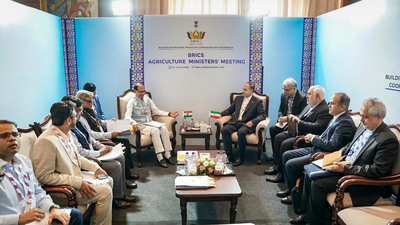
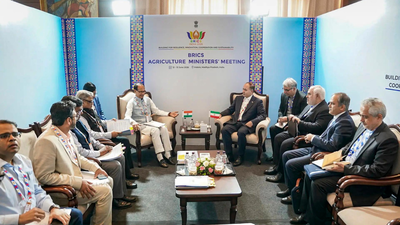
BRICS nations on Saturday adopted the “Indore Declaration”, committing to deeper cooperation in agriculture and launching a series of new initiatives, including a global forum on farmers’ seed rights, a digital agriculture network and a platform for agroecology and regenerative farming, PTI reported.The decisions were taken at the end of a five-day meeting of agriculture ministers and officials from BRICS countries held under India’s presidency.Union Agriculture Minister Shivraj Singh Chouhan said the member countries agreed on several new institutional mechanisms, with India taking on a coordinating role in many of them.According to the Indore Declaration, BRICS countries reaffirmed their commitment to strengthening food and nutrition security, improving the livelihoods of small and marginal farmers, increasing the participation of women and youth in agriculture, promoting climate-resilient and sustainable farming, and enhancing cooperation in agricultural trade and investment.The member nations also reiterated their commitment to a “fair, inclusive and transparent” multilateral trading system and discussed measures to facilitate agricultural trade.
Global forum on farmers’ seed rights
Among the key decisions, BRICS nations agreed to establish a ‘Global Forum on Farmers’ Rights in Seed Systems’ to promote farmers’ rights and preserve traditional knowledge linked to seed systems.“India will coordinate this initiative,” Chouhan said.The forum will focus on farmers’ seed rights, conservation of indigenous seed diversity and preservation of traditional agricultural knowledge.
India to coordinate AGRIN Network
The member countries also agreed to create the BRICS AGRIN Network to facilitate cooperation in agricultural inputs, genetic resources and information-sharing.India will serve as the coordinating country for the network.According to Chouhan, the platform will support the exchange of agricultural resources, technical information and best practices among member nations.
Grain exchange proposal moves forward
The grouping also agreed to continue discussions on operationalising the proposed “BRICS Grain Exchange”, aimed at strengthening foodgrain trade and supply chains among member countries.Chouhan said the initiative could improve foodgrain trade, market linkages and supply-chain cooperation across BRICS nations.
Focus on climate-resilient farming
In response to challenges posed by climate change, BRICS countries agreed to establish a ‘BRICS Centres of Excellence Network’ in agroecology and regenerative agriculture.The Indian Institute of Farming Systems Research, Modipuram, functioning under the Indian Council of Agricultural Research (ICAR), will undertake the initial coordination work.
Digital agriculture network approved
The member nations also endorsed the creation of a Digital Agriculture Network to promote the use of artificial intelligence (AI), Internet of Things (IoT), geospatial technologies and other digital solutions in agriculture.Initial coordination for the network will be handled by the Indian Institute of Technology (IIT) Delhi.
Research platform to become action hub
Chouhan said BRICS countries had also agreed to strengthen the BRICS Agricultural Research Platform and transform it into a “Knowledge to Action Hub” to ensure research outcomes reach farmers more quickly.According to the minister, the initiatives are aimed at empowering small and marginal farmers, strengthening food security and making agriculture more sustainable and resilient.Around 100 delegates, including nearly 60 foreign representatives from member and partner countries, participated in the five-day meeting.Chouhan said the decisions reflected the shared commitment of BRICS countries to address common agricultural challenges through innovation, technology and knowledge-sharing.He noted that BRICS nations represent nearly half of the world’s population, account for about 42% of global agricultural land and contribute roughly 42% of global foodgrain production.Greater cooperation among the countries could play an important role in strengthening global food security, he added.BRICS comprises Brazil, Russia, India, China and South Africa. The bloc has since expanded to include Egypt, Ethiopia, Iran, Saudi Arabia, the United Arab Emirates and Indonesia.


