
I spy with my little eye: Your TV may be tracking what you watch
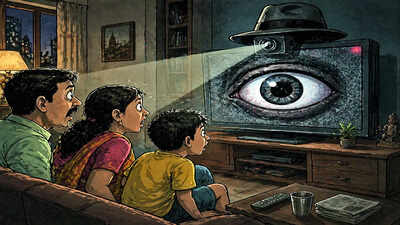
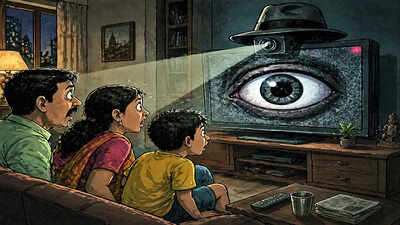
India’s smart TV boom has brought a sharper, more uncomfortable question into the living room: is your television quietly watching you back? The question arises due to a lesser-known feature called automatic content recognition (ACR), a technology built into many internet-connected TVs that can identify what’s playing on screen by analysing audio snippets or pixel patterns. In effect, ACR can “fingerprint” content – whether it’s a Netflix show, a YouTube video, or even something streamed via HDMI from a laptop or gaming console – and convert that into metadata.The issue is not unique to India. It has recently drawn attention in US after a viral online post pointed to research showing that some smart TVs may continue sending ACR-related data even when used as external displays.The underlying study found such tracking behaviour on certain Samsung and LG sets.The concern, privacy experts say, is far from theoretical. ACR, when enabled, can extend beyond apps and into everything displayed on the screen. “Most users assume privacy settings on Netflix or YouTube are enough. They don’t realise the TV hardware itself can fingerprint the pixels,” said Neehar Pathare, MD, CEO and CIO at 63SATS Cybertech. That includes potentially sensitive material such as personal photos or financial documents viewed via a connected laptop.Industry researchers say the scale of tracking is often underestimated. “For the overwhelming majority of consumers, ACR runs with minimal awareness. It is often enabled by default and continuously samples screen content to build a detailed behavioural profile,” said Prabhu Ram, VP-Industry Research Group at CyberMedia Research. “This data can be combined with other identifiers and shared with third parties,” he added.For brands, the messaging is more cautious. Keshav Bansal, director at Intex Technologies, said the company does not deploy independent ACR-based tracking at the device level. Instead, it relies on platform-led consent systems such as those within Google TV and OTT apps. “We focus on screen-level performance, not screen-level surveillance,” he said, adding that Intex TVs are not designed to track content from external sources and do not monetise user-level viewing data.But the broader market remains opaque. Queries sent to major smart TV brands, including LG, Sony, Samsung and Xiaomi, on their ACR practices, consent mechanisms and data usage policies went unanswered for days.That lack of clarity is becoming harder to ignore as India enforces its Digital Personal Data Protection Act. Under the law, smart TV makers qualify as “data fiduciaries”, meaning they must clearly justify what data is collected, why it is needed, and ensure consent is explicit and unambiguous.Industry observers say current implementations may fall short. Smart TV interfaces often present long, complex privacy agreements – sometimes bundled with software updates – leading to what Pathare calls “consent fatigue”. Users click through, not necessarily because they agree, but because they want the TV to work. Globally, regulators have already stepped in. In the US, TV makers have faced enforcement action over undisclosed ACR tracking, including a penalty against Vizio for collecting viewing data without proper consent. In Europe, GDPR rules require explicit, granular opt-in before such data collection begins.For consumers, the safeguards are neither simple nor obvious. Experts recommend digging into TV settings to disable options labelled “viewing data” or “interest-based advertising”, and, in some cases, blocking tracking domains at the network level. Others suggest treating a smart TV like any other connected device – keep it updated, review privacy settings after software updates, or disconnect it from the internet entirely when smart features are not needed.The bigger issue, though, is awareness. As Pathare puts it, ACR turns the television into a “two-way mirror”. The screen may look passive, but behind it sits a system capable of observing patterns, preferences and behaviour. In a country where the TV remains the centrepiece of the household, the idea that it might also be a data collection node raises a question regulators and manufacturers can no longer sidestep: when you switch on your TV, who else is tuning in?


