Poll of exit polls 2026: Bengal cliffhanger, Congress in Kerala; status quo in Tamil Nadu, Assam, Puducherry – predictions decoded | India News
NEW DELHI: West Bengal could be on the cusp of “poriborton” with the exit polls predicting a hung assembly that could mark the end of Mamata Banerjee’s 15-year-old rule in the state. Most of the exit polls projected a neck-and-neck race between the ruling Trinamool Congress (TMC) and the BJP in West Bengal.And the other big surprise, if one pollster is to be believed, could come from the south where actor-politician Vijay’s TVK may end the DMK-AIADMK duopoly in Tamil Nadu by emerging as the single largest party. However, most of the other pollsters have given a clear edge to the DMK-Congress alliance in the state.
In Assam, the BJP is predicted to score a hat-trick of victories with a big win over the Congress, which continues to struggle in the northeastern state.While in Kerala, the CPM-led LDF may be on its way out marking the end of the only Left government in the country. In Puducherry, the ruling NDA is likely to retain power with a comprehensive victory over the Congress-DMK alliance.Exit polls released on Wednesday after the conclusion of voting across four states and one Union Territory (UT) offered an indecisive picture, where entrenched incumbencies, rising challengers and new entrants may simultaneously shape electoral outcomes if the exit polls numbers hold.With results scheduled for May 4, the projections reflect both continuity and churn across regions, underscoring how state-specific dynamics continue to define voter behaviour.
Poll of polls
Bengal a nail-biter!
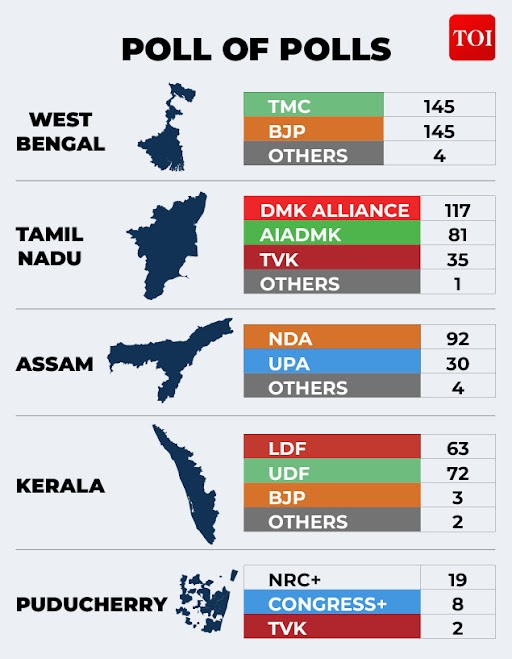
In West Bengal, the numbers point to one of the most fiercely fought contests in recent memory.While individual exit polls vary, the broader trend suggests a sharply polarised electorate split almost evenly between the TMC and the Bharatiya Janata Party (BJP), which left no stone unturn to dent Mamata’s citadel.A poll of polls placed both parties at approximately 145 seats each in the 294-member assembly, with smaller parties and independents expected to secure only a marginal presence.Such projections indicate not merely a competitive race but a possible structural shift in the state’s politics.If exit polls are to be believed, the BJP, once a peripheral force in West Bengal, appears to have consolidated its position as the principal challenger, eroding the dominance of the ruling TMC.At the same time, the TMC’s ability to retain parity in these projections suggests that the incumbent still commands significant grassroots support, particularly in key districts that recorded high voter turnout.The turnout itself, hovering around 90 percent in both phases of Bengal polls, which is highest since Independence, reflects intense voter engagement.Districts such as Purba Bardhaman, Hooghly, Nadia and Howrah reported particularly strong participation, suggesting that the electoral stakes were widely recognised by voters across regions. High turnout in tightly contested elections often introduces an additional layer of unpredictability, making the eventual outcome harder to forecast despite near-even projections.
Suprise awaits Tamil Nadu?
In Tamil Nadu, the electoral story is more nuanced, with a bold prediction by Axis My India.Most exit polls indicate that the DMK-led alliance under chief minister M K Stalin is on course to retain power, albeit with a reduced margin compared to its 2021 performance.This would mark a significant political moment in a state historically characterised by alternating mandates between the two Dravidian majors. Retaining power consecutively would signal a degree of stability and voter endorsement that has often eluded incumbents in Tamil Nadu.However, the emergence of Tamilaga Vettri Kazhagam (TVK), led by actor-politician Vijay, introduces a new variable into what has traditionally been a bipolar contest.While most projections stop short of placing TVK ahead of established parties, they consistently indicate that the party is cutting into existing vote bases. Even conservative estimates suggest that TVK could influence outcomes in multiple constituencies by redistributing votes, while more optimistic projections, such as those by Axis My India, point to a far more disruptive scenario where the party could secure between 98 and 120 seats.If such projections were to materialise, Tamil Nadu could witness a fundamental reconfiguration of its political structure, moving away from the long-standing DMK-AIADMK duopoly towards a more competitive, multi-polar framework. At the same time, projections for the AIADMK indicate a partial recovery but also highlight continuing organisational and leadership challenges that may limit its ability to fully capitalise on anti-incumbency sentiment.
Status-quo in Assam?
Assam, by contrast, appears to be heading towards political continuity. Exit polls from multiple agencies converge on a clear outcome of BJP’s sweep under chief minister Himanta Biswa Sarma.The poll of polls suggests the BJP could secure around 90 seats, significantly ahead of the Congress, which is projected to remain around the 30-seat mark, with others accounting for a small fraction of the assembly.These projections reinforce the BJP’s entrenched position in the state, where it has steadily expanded its organisational base and electoral reach over successive election cycles.For the Congress, the numbers underline persistent structural challenges, with limited evidence of a resurgence despite attempts to recalibrate its campaign strategy. The outcome, if it aligns with exit poll projections, would mark a third consecutive term for the BJP, further consolidating its dominance in the northeastern region.
Congresss predicted to win Kerala
Kerala presents perhaps the most analytically complex scenario among the five contests. Exit polls suggest a closely fought election between the Left Democratic Front and the Congress-led United Democratic Front.While the poll of polls indicates a slight edge for the UDF with around 72 seats in the 140-member assembly, the LDF is projected not far behind at approximately 63 seats, pointing to a narrow margin that could shift depending on constituency-level variations.At the same time, divergent projections from agencies such as Axis MyIndia and PMARQ highlight the uncertainty embedded in the Kerala contest.While Axis My India suggested a wider gap favouring the UDF, PMARQ predicted a majority for the ruling LDF, indicating that the final outcome remains open.This variability reflects Kerala’s unique electoral behaviour, where small swings in vote share can translate into significant seat changes due to the state’s competitive constituency landscape.The broader significance of the Kerala election lies in its departure from historical patterns. The state has traditionally alternated between the LDF and the UDF, but the LDF’s consecutive victory in 2021 disrupted this cycle.The 2026 election, therefore, becomes a test of whether that break from tradition represents a longer-term shift or a temporary deviation. A defeat for the LDF would also have implications beyond the state, potentially weakening the national footprint of the Left, for which Kerala remains a principal stronghold.Campaign narratives in Kerala have also evolved over time, with early phases dominated by issues such as corruption allegations, economic concerns, administrative controversies and localised grievances, including rehabilitation challenges following the Wayanad landslide and the Sabarimala gold heist controversy. These factors have contributed to a more issue-driven contest, where voter decisions may hinge on governance performance as much as political alignment.
NDA again in Puducherry?
In Puducherry, exit polls suggest a clearer outcome relative to some of the larger states. The ruling NDA, led locally by the AINRC-BJP combine, is projected to retain power against the Congress-DMK alliance. High voter turnout, recorded at nearly 89.83 percent, indicates strong public engagement, while several constituencies witnessed closely contested races.The entry of Tamilaga Vettri Kazhagam has added an additional layer of competition in Puducherry as well, particularly in constituencies with socio-political overlaps with neighbouring Tamil Nadu. However, despite this added complexity, most projections suggest that the incumbent alliance retains a decisive advantage, reflecting either sustained voter support or fragmentation within the opposition vote base.Across all five contests, a few common themes emerge according to the exit polls.First, the role of new political entrants, particularly in Tamil Nadu and Puducherry, highlights the fluidity of voter preferences and the potential for rapid shifts in established political orders. Second, the varying degrees of incumbency advantage or disadvantage across states reflect the importance of local governance and regional narratives, particuarly in Bengal where SIR has played a crucial role.As with all exit polls, these projections must be interpreted with caution. While they provide a directional sense of the electoral mood, they are not definitive predictors of final outcomes. Variations in sampling, methodology and last-mile voter behaviour can produce results that diverge from exit poll estimates.With counting scheduled for May 4, the final verdict will determine whether the trends indicated by these projections translate into actual electoral outcomes or whether voters have delivered surprises that defy pre-result expectations. Until then, the exit polls serve as an informed but provisional outlook of a politically dynamic moments in the states and the UT under elections.